
Guangzhou A.C.T Products Co.,Ltd To Make The Global Delivery More Efficient
Why Food Delivery Bag Shipping Costs Surprise Bulk Buyers
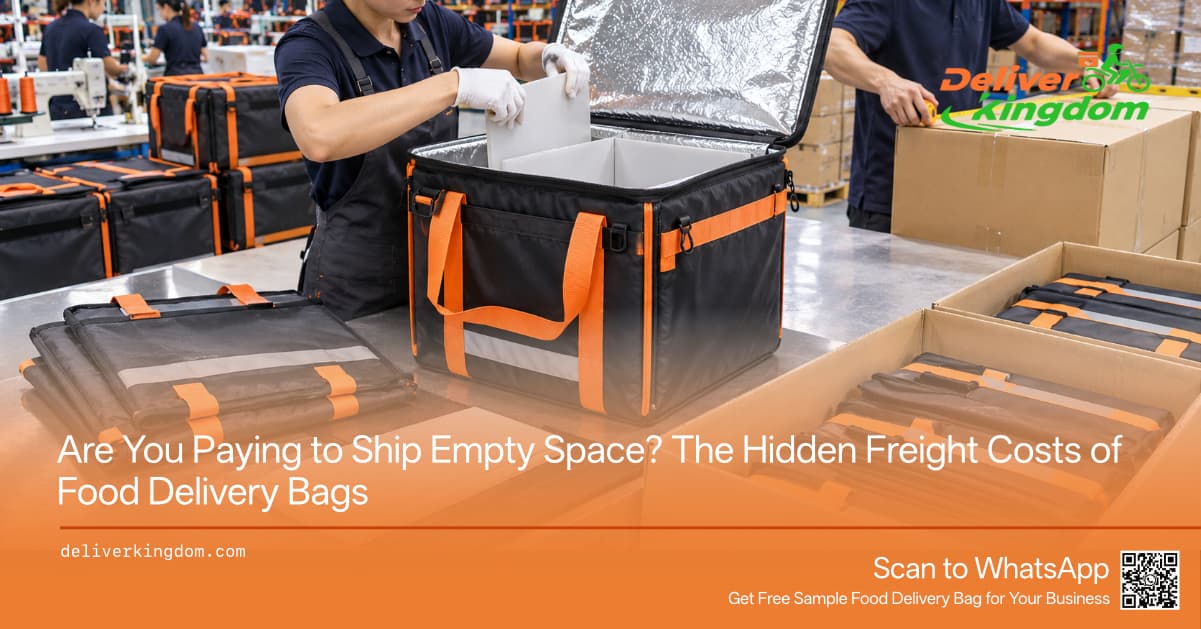
A purchasing manager finds a food delivery bag that looks perfect for a new restaurant delivery fleet. The size is right, the insulation feels solid, the logo printing looks clean, and the factory quotation fits the budget. Then the shipping quotation arrives. Suddenly, a product that appeared affordable becomes noticeably more expensive. The problem is not always the freight rate itself. Sometimes the bags simply occupy too much space inside export cartons. A structured food delivery bag may travel thousands of kilometers while carrying absolutely nothing, yet its empty interior still takes up valuable shipping volume. For restaurant chains, delivery platforms, food logistics companies, and international trading businesses, this is a real purchasing issue. Foldable food delivery bags for bulk shipping can help reduce unnecessary packing volume when their structures are designed to collapse efficiently. DeliverKingdom has specialized in insulated delivery equipment manufacturing since 2013, supporting commercial buyers who need practical products as well as more efficient export arrangements. Its production facility in Yangchun, Guangdong, covers more than 12,000 square meters and employs over 400 workers. Rather than treating packaging as something to consider after manufacturing, DeliverKingdom can incorporate folding requirements, carton dimensions, and shipment methods into OEM and ODM product development. That matters when a buyer is ordering thousands of units instead of a few samples.
How Carton Dimensions Can Change the Real Cost of Every Bag
International buyers usually compare food delivery bag prices on a per-unit basis, but the factory price is only one part of the landed cost. Shipping companies and freight forwarders also consider cargo volume, actual weight, shipment route, and applicable chargeable-weight rules. For ocean freight, carton dimensions influence the cubic meters occupied by the shipment, while air freight often uses volumetric-weight calculations. Take a simple illustration: a carton measuring 60 × 40 × 40 cm occupies 0.096 cubic meters. A carton measuring 60 × 40 × 20 cm occupies only 0.048 cubic meters. That is half the volume, although the real saving depends on how many bags fit inside each carton and whether the revised packing arrangement is practical. This is why an OEM food delivery bag manufacturer in China should discuss packing methods before bulk production. DeliverKingdom can work with buyers to evaluate folding structures, removable support panels, carton arrangements, and protective packaging based on the approved product design. Foldable food delivery bags for bulk shipping are particularly useful when buyers need to distribute products to multiple warehouses or countries. A more compact packing arrangement may improve container space utilization, reduce storage requirements, and make equipment distribution easier. However, the objective should never be to compress bags so aggressively that insulation becomes permanently deformed or the product arrives damaged. Saving freight costs is useful only when the bags still perform correctly after unpacking.
Foldable Food Delivery Bags That Save Space Without Losing Their Shape
A professional food delivery bag needs enough structure to carry meals securely, but that does not mean every supporting component must remain permanently rigid. Foldable designs can combine flexible insulated walls with removable bottom panels, detachable support boards, reinforced seams, and quick-assembly closures. When the bag is required for delivery, the panels help it stand upright and maintain a suitable loading space. When it is empty, selected structural components can be removed or repositioned so the bag folds flatter. DeliverKingdom supports different assembly options, including Velcro connections, zipper systems, reinforced fabric hinges, and removable internal supports. These designs can be developed according to the required carrying capacity, insulation thickness, food packaging, and frequency of assembly. Foldable food delivery bags for bulk shipping can offer advantages beyond international transport. Restaurant chains may store spare equipment in limited back rooms, while logistics companies may distribute flattened bags to regional depots before new riders begin work. The important detail is how well the bag returns to its intended shape. Weak fold lines, badly positioned support panels, or loose connections can create problems after repeated use. DeliverKingdom's OEM and ODM development allows buyers to confirm folding geometry, panel placement, and assembly convenience through sampling. A well-designed foldable food delivery bag should be convenient to store without becoming unstable when it is finally loaded with hot meals and drinks.
Why Insulation and Foldability Need to Be Designed Together
Foldability is attractive for transport and storage, but an insulated food delivery bag still has an important job to do after assembly. It must help slow heat exchange, protect food packaging, and maintain its shape during movement. Poorly designed folding points can create gaps between insulated panels, especially near corners and closure areas. Repeated bending may also compress certain insulation materials or damage reflective lining if the structure is not intended for frequent folding. This is why a custom insulated food delivery bag for restaurant chains should be developed with both thermal performance and packing requirements in mind. DeliverKingdom can work with materials such as Oxford fabric, PVC-coated polyester, TPU-coated fabric, EPE foam, aluminum foil lining, and PEVA inner surfaces. The insulation thickness, panel layout, fastening method, and outer construction can be adjusted according to the project. For example, a restaurant chain operating short urban delivery routes may prioritize lightweight construction and convenient folding, while a catering service transporting meals for longer periods may require more substantial insulation and structural support. Buyers should evaluate a sample after it has been folded, unpacked, and assembled, not only when it is fresh from production. Actual thermal retention needs to be verified under representative conditions. The goal is to create equipment that balances storage efficiency, insulation, durability, and daily usability rather than sacrificing one requirement simply to make the export carton smaller.
How Compact Packaging Helps Restaurant Chains Distribute Equipment Faster
Large restaurant chains often need delivery equipment in several locations at the same time. A headquarters team may purchase thousands of food delivery bags, receive them at a central warehouse, and then distribute smaller quantities to individual restaurants, franchise operators, or regional rider depots. Bulky packaging creates additional work throughout this process. Cartons occupy more warehouse space, internal transfers may require more vehicle capacity, and individual stores may struggle to keep replacement bags in already crowded storage rooms. Custom insulated food delivery bags for restaurant chains can be developed with compact packing and simple assembly in mind. DeliverKingdom supports customized dimensions, foldable structures, reinforced panels, color matching, logo printing, and packaging arrangements suited to commercial distribution. A restaurant group launching 40 new locations, for example, may want each store to receive a defined number of delivery bags in clearly identified cartons. Foldable products can make stock allocation easier, provided each bag can be assembled correctly and its components remain together. Buyers may also request individual protective sleeves, grouped carton packing, or identification labels depending on warehouse procedures. These decisions can be incorporated into the purchasing specification before production begins. With more than a decade of delivery equipment experience, DeliverKingdom understands that successful supply involves more than producing a functional bag. The product must also arrive safely, move efficiently through distribution channels, and be ready for use when the next restaurant opens.
Choosing Durable Materials for Repeated Folding and Daily Delivery
A foldable food delivery bag must survive two different working conditions. During storage and shipping, it may remain compressed or folded for extended periods. During actual delivery, it is opened, loaded, lifted, carried, cleaned, and occasionally exposed to rain, dust, oil, and food spills. Materials that perform well in only one of these situations may create problems over time. DeliverKingdom can customize food delivery bag construction using waterproof or water-resistant coated fabrics, suitable insulation foam, easy-clean inner linings, reinforced webbing, durable stitching, and removable support boards. Particular attention should be paid to corners, fold lines, handle attachments, and closure positions because these areas experience repeated mechanical stress. A bag may also require zipper or Velcro systems that allow quick assembly without leaving large gaps around the insulated compartment. For businesses ordering foldable food delivery bags for bulk shipping, sample evaluation should include repeated folding and assembly cycles alongside normal loading tests. The buyer should check whether panels remain aligned, insulation recovers its intended shape, and handles stay secure after repeated use. Waterproof performance should also be considered at seams and closures rather than assumed from the outer fabric alone. DeliverKingdom's customization capabilities allow buyers to select construction details based on their operating environment, whether that means motorcycle delivery in rainy cities, catering distribution, or restaurant fleets handling dozens of orders each day.
Custom Food Delivery Bags Built for Branding and International Markets
Food delivery equipment often serves as a moving part of a restaurant brand's identity. Riders carry bags through residential neighborhoods, office buildings, restaurant pickup areas, and busy city streets. A faded logo or inconsistent color may not affect the food directly, but it changes how professional the delivery service appears. For international restaurant chains and delivery companies, consistent branding becomes more difficult when products are purchased from different suppliers across several markets. DeliverKingdom supports custom insulated food delivery bags for restaurant chains with flexible dimensions, materials, colors, insulation structures, opening systems, and printing options. Buyers can request Pantone-based color matching, silk screen printing, heat transfer printing, embroidery, woven labels, PVC patches, or reflective printing according to project requirements. The bag can also include internal dividers, separate drink compartments, order identification pockets, reinforced handles, and adjustable shoulder straps. Material choices may vary depending on climate and application. A rainy market may require stronger attention to water resistance, while a high-frequency courier fleet may prioritize carrying comfort and durable construction. DeliverKingdom also manufactures rider helmets, jackets, and protective equipment, allowing businesses to coordinate several delivery equipment categories through one manufacturing relationship. As an OEM food delivery bag manufacturer in China, DeliverKingdom can help buyers maintain a consistent visual identity while adapting products to different local delivery requirements. This combination of customization and coordinated sourcing is especially useful for trading companies serving multiple regional customers.
What Procurement Teams Should Check Before Approving Bulk Packaging
Before approving a large food delivery bag order, procurement teams should examine the product and its packing method together. A supplier may provide an excellent sample, but if the bulk packing requires excessive folding, the finished bags may arrive with distorted panels, compressed insulation, or damaged accessories. Buyers should request the proposed carton dimensions, number of bags per carton, gross weight, net weight, and estimated total shipment volume. They should also understand whether each bag requires separate assembly and whether support panels, straps, or other components are packed securely with the correct unit. A useful packing review involves opening a trial carton, removing the product, assembling it, loading real food containers, and confirming that the bag returns to its approved shape. For foldable food delivery bags for bulk shipping, this can be combined with basic handling, stacking, and transportation evaluations according to the project. DeliverKingdom supports OEM and ODM sampling and can discuss packing arrangements before bulk production begins. Buyers working with an OEM food delivery bag manufacturer in China should also clarify whether carton dimensions may change after final sample approval, since changes in material thickness or reinforcement can influence packing volume. Documenting these details reduces misunderstandings between the manufacturer, freight forwarder, warehouse, and final customer. A reliable purchasing decision should consider the complete shipment, not just the unit price printed at the top of the quotation.
Why Choose DeliverKingdom for OEM Food Delivery Bag Manufacturing
Choosing a food delivery bag manufacturer involves evaluating more than sewing capability. Commercial buyers need reliable customization, appropriate material selection, sample development, quality management, export packing, and the ability to reproduce approved specifications for future orders. DeliverKingdom was established in 2013 and is headquartered in Guangzhou, China. Its manufacturing facility in Yangchun, Guangdong covers more than 12,000 square meters and employs over 400 workers. The company holds BSCI and ISO9001 certification, providing international purchasing teams with recognized references for factory practices and quality-management systems. DeliverKingdom specializes in food delivery bags, insulated tote bags, thermal backpacks, rider helmets, jackets, and protective gear. This broader manufacturing scope makes it suitable for restaurant chains and delivery operators looking to source coordinated fleet equipment. As an OEM food delivery bag manufacturer in China, DeliverKingdom supports fabric customization, dimensional adjustments, insulation thickness selection, logo printing, color matching, divider development, foldable construction, and commercial production. Buyers can discuss not only how the bag should perform during delivery but also how it should be packed, transported, stored, and distributed. The company can work from existing product references or buyer-defined specifications to develop an appropriate sample. With substantial factory space and an experienced workforce, DeliverKingdom provides a manufacturing foundation for bulk orders and repeat supply. For restaurant groups, food logistics providers, catering businesses, cold chain operators, and international traders, the advantage is having a supplier that can address both product requirements and practical purchasing considerations.
Building a Smarter Food Delivery Bag Supply Plan from Factory to Fleet
A successful bulk food delivery bag project should begin with the actual application and the intended distribution process. Buyers should define what food containers the bags need to carry, how long delivery routes usually take, which vehicles riders use, how often the bags will be folded, and where they will be stored between shifts. They should also confirm the destination market, expected order quantity, branding requirements, preferred materials, and any restrictions on shipping carton dimensions. These details help determine whether a foldable structure is suitable and which components should remain rigid during normal operation. DeliverKingdom can develop foldable food delivery bags for bulk shipping, custom insulated food delivery bags for restaurant chains, or more structured models for businesses that place greater emphasis on maximum support. The OEM and ODM process can include fabric selection, dimension confirmation, insulation adjustment, logo printing, color matching, closure design, removable support panels, sample development, and packing review. Buyers can compare sample structures using real meal containers and request carton measurements before approving commercial production. This helps reduce the risk of receiving equipment that performs well in isolation but creates unnecessary costs during storage and distribution. DeliverKingdom supports large commercial orders and repeat production for restaurant chains, delivery platforms, catering companies, food logistics providers, and trading businesses. Procurement teams can begin by providing their preferred bag dimensions, food packaging measurements, estimated quantity, destination country, logo artwork, and desired packing method. With this information, DeliverKingdom can discuss a suitable product configuration, sample requirements, and an accurate manufacturing quotation. The objective is not simply to make the shipping carton smaller. It is to deliver a food delivery bag that protects meals, works comfortably for riders, supports brand consistency, and makes commercial purchasing more efficient from the factory floor to the final delivery fleet.
Q: Can foldable food delivery bags reduce international shipping costs?
A: Foldable food delivery bags may reduce shipping volume when they can be packed more compactly without damaging the insulation or structure. Actual savings depend on the number of bags per carton, carton dimensions, freight method, destination, and applicable shipping charges. Buyers should compare confirmed packing measurements rather than assuming a fixed saving percentage.
Q: Can DeliverKingdom customize foldable food delivery bags for bulk orders?
A: Yes. DeliverKingdom supports foldable structures with removable support boards, flexible sidewalls, zipper or Velcro assembly options, custom insulation, reinforced handles, and waterproof fabric selections. The final structure can be developed around the customer's food packaging, required dimensions, delivery environment, and shipment requirements.
Q: Will repeatedly folding an insulated food delivery bag damage its thermal performance?
A: Repeated folding can affect certain insulation materials or structural components if they are not designed for that use. DeliverKingdom can develop suitable folding structures and material combinations for the intended application. Buyers should evaluate the sample after repeated folding and assembly, including any required thermal performance testing.
Q: Why choose DeliverKingdom as an OEM food delivery bag manufacturer in China?
A: DeliverKingdom has specialized in delivery equipment since 2013 and operates a manufacturing facility covering more than 12,000 square meters with over 400 workers. The company supports OEM and ODM development, custom fabrics, sizes, colors, logos, insulation structures, foldable designs, export packing, and large commercial orders. DeliverKingdom also holds BSCI and ISO9001 certification.
Q: What information should buyers provide before requesting a bulk quotation?
A: Buyers should provide the required bag dimensions, estimated order quantity, food container sizes, delivery application, preferred fabric and insulation, logo artwork, color requirements, destination country, and any packing preferences. If compact shipping is a priority, buyers should also specify whether they prefer foldable construction, removable panels, or particular carton size limits.

 Obtenga una cotización en línea